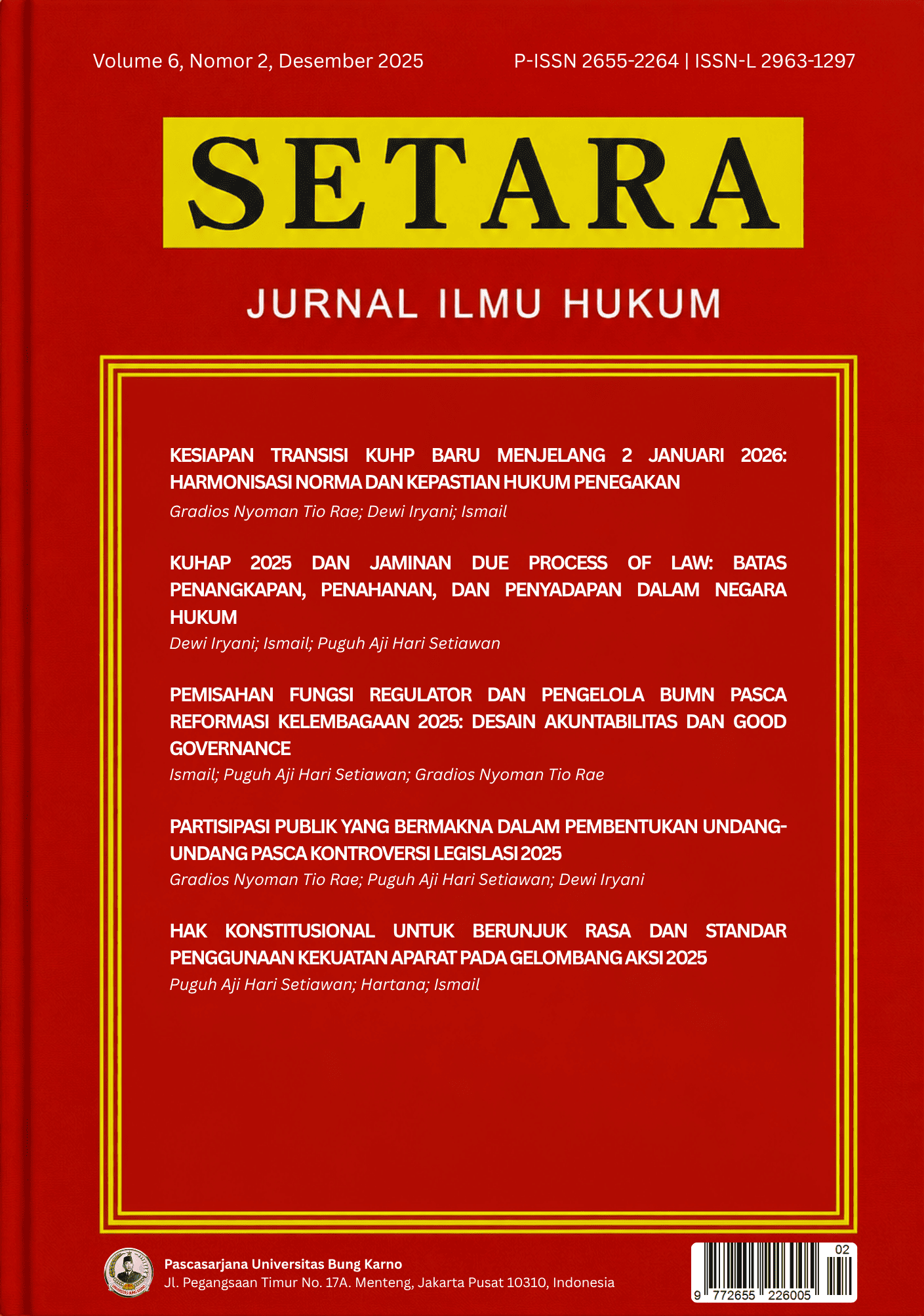
Hak Konstitusional untuk Berunjuk Rasa dan Standar Penggunaan Kekuatan Aparat pada Gelombang Aksi 2025
Authors


DOI
10.59017/setara.v6i2.590
Keywords:
Right to Protest, Use of Force, Human Rights, Proportionality, Constitutional RightsAbstract
This article examines the constitutional right to protest and the legal standards governing the use of force by state apparatus during the 2025 protest waves in Indonesia. The issue is constitutionally important because a democratic rule-of-law state must simultaneously protect freedom of assembly and ensure that law enforcement action remains bound by legality, necessity, and proportionality. Using normative legal research with statutory, conceptual, and human-rights approaches, this article analyses the 1945 Constitution, Law Number 9 of 1998, Law Number 39 of 1999, Law Number 2 of 2002, Law Number 12 of 2005, and the regulatory framework on police use of force, supported by relevant legal scholarship and international standards. The article argues that Indonesian law already recognizes the right to assemble and imposes human-rights obligations on policing, but normative gaps and weak accountability still allow excessive or indiscriminate force in crowd control. Therefore, the legal framework must be read through a stricter standard of legality, necessity, proportionality, escalation, reporting, and effective review of force incidents.
References
Hairi, P. J. (2012). Prinsip dan standar hak asasi manusia dalam pengamanan unjuk rasa. Negara Hukum, 3(1), 115-130.
United Nations. (1966). International covenant on civil and political rights. Retrieved June 14, 2026, from https://www.ohchr.org/en/instruments-mechanisms/instruments/international-covenant-civil-and-political-rights
United Nations. (1979). Code of conduct for law enforcement officials. Retrieved June 14, 2026, from https://www.ohchr.org/en/instruments-mechanisms/instruments/code-conduct-law-enforcement-officials
United Nations. (1990). Basic principles on the use of force and firearms by law enforcement officials. Retrieved June 14, 2026, from https://www.ohchr.org/en/instruments-mechanisms/instruments/basic-principles-use-force-and-firearms-law-enforcement
Indonesia. (1945). Undang-undang dasar negara republik indonesia tahun 1945. Retrieved June 14, 2026, from https://www.dpr.go.id/dokumen/jdih/undang-undang-dasar
Indonesia. (1998). Undang-undang nomor 9 tahun 1998 tentang kemerdekaan menyampaikan pendapat di muka umum. Retrieved June 14, 2026, from https://peraturan.bpk.go.id/Details/45370/uu-no-9-tahun-1998
Indonesia. (1999). Undang-undang nomor 39 tahun 1999 tentang hak asasi manusia. Retrieved June 14, 2026, from https://peraturan.bpk.go.id/Details/45361/uu-no-39-tahun-1999
Indonesia. (2002). Undang-undang nomor 2 tahun 2002 tentang kepolisian negara republik indonesia. Retrieved June 14, 2026, from https://peraturan.bpk.go.id/Details/44418/uu-no-2-tahun-2002
Indonesia. (2005). Undang-undang nomor 12 tahun 2005 tentang pengesahan international covenant on civil and political rights (kovenan internasional tentang hak-hak sipil dan politik). Retrieved June 14, 2026, from https://peraturan.bpk.go.id/Details/40261/uu-no-12-tahun-2005
PID Polda Kepri. (2022, May 9). Peraturan kapolri nomor 1 tahun 2009 tentang penggunaan kekuatan dalam tindakan kepolisian. Retrieved June 14, 2026, from https://pid.kepri.polri.go.id/peraturan-kapolri-nomor-1-tahun-2009-tentang-penggunaan-kekuatan-dalam-tindakan-kepolisian/
Downloads
Published
Issue
Section
License
Copyright (c) 2025 Puguh Aji Hari Setiawan, Hartana, Ismail (Author)

This work is licensed under a Creative Commons Attribution 4.0 International License.